
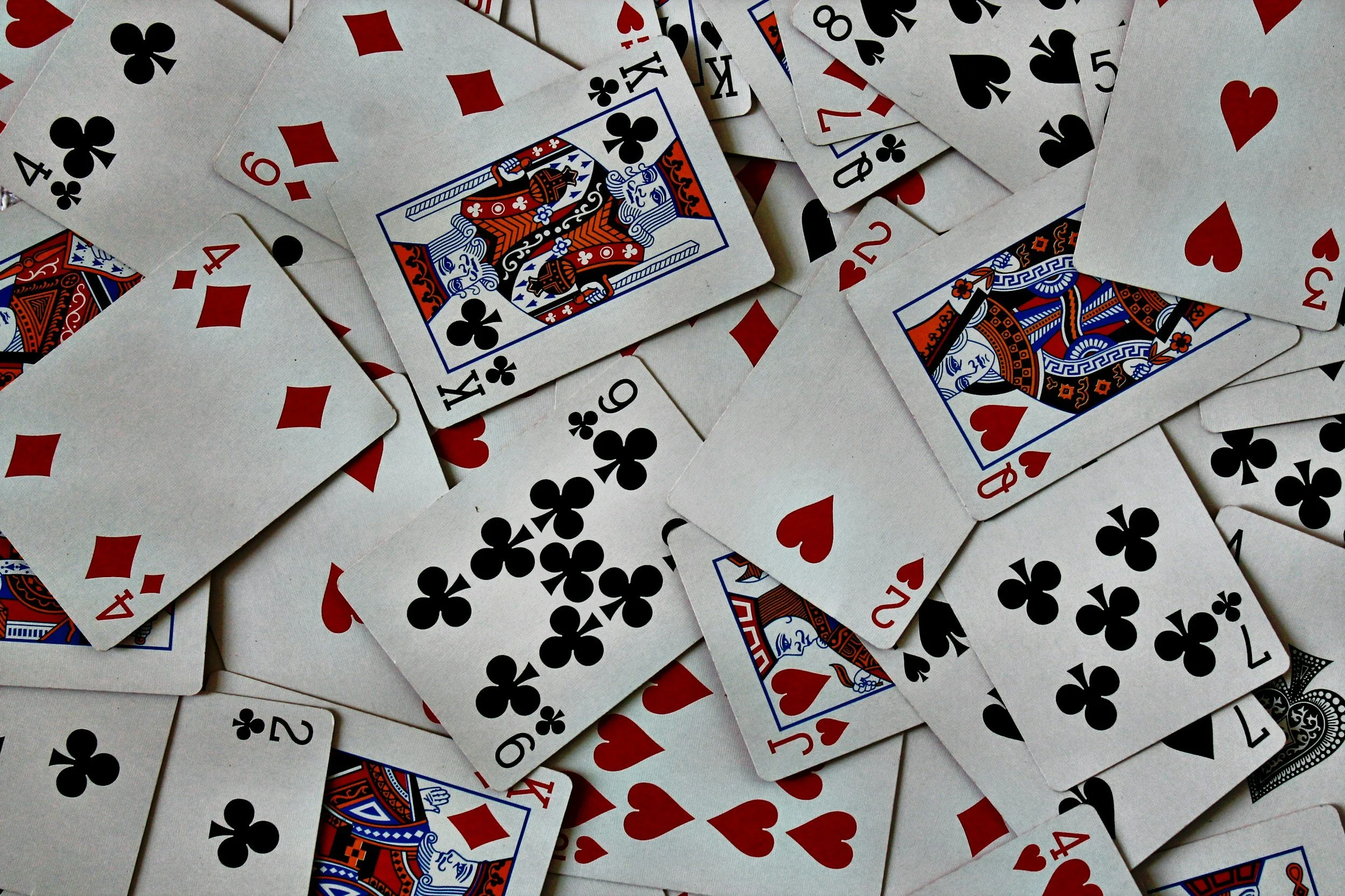
GOPS, Game of Pure Strategy, also known as Goofspiel, is a two-player card game of blind bidding. You bid against your opponent for prize cards you can both see, using bidding cards they can't see. It was invented in the 1930s by Merrill Flood, an American mathematician at Princeton, and it has the rare quality of being learnable in two minutes while still being genuinely hard to master.
That gap, trivial rules, real decisions, is what makes it the best opener for a night of cards. Anybody can be playing within a minute, and the person who wins will have earned it.
Players: 2 (variations for 3+)
Time: 10–15 minutes
Deck: One standard 52-card deck
Skill, Bidding, memory, nerve
Setup
Separate the deck into suits. Each player takes one suit as their bidding hand — traditionally spades and clubs. Diamonds become the prize suit. Hearts are set aside and not used.
Shuffle the prize suit and turn the top diamond face up in the center of the table. That's the first prize card.
Play
Each round, both players choose one card from their bidding hand to bid on the prize card in the middle. Bids are placed face down, then revealed at the same time.
The higher bid wins the prize card and adds it to their score pile. Both bidding cards are discarded, win or lose — so every card you spend is spent for good.
Ties
If both players bid the same rank, the prize is not collected. Instead, turn up another prize card, so there are now two cards in the middle, and bid again — both players using a fresh card from their hand.
That continues for as long as the tie holds. The pot grows with every tie, which means a standoff early in the game can turn into the largest single swing of the whole hand. (Tying and re-bidding is our house rule. Many published versions carry the prize card into the next round instead — either works, but agree on one before you deal.)
Scoring
Play ends when both players have run out of bidding cards. Add up the prize cards you collected:
Ace = 1
2–10 = face value
Jack = 11
Queen = 12
King = 13
Highest total wins. The full prize suit adds up to 91 points, so if you're counting, you can work out exactly how the game stands.
Strategy
Because prize cards are worth their face value, the obvious move is to bid high on kings. The obvious move is not the winning one.
Your high bidding cards are scarce. You have one 13 and one 12. Spending the 13 to win a king nets you 13 points but costs you the chance to win the queen, the jack, and everything after. Winning a king with a 13 is roughly a wash; winning it with a 9 is a profit.
Bid to the prize, not to the points. A 7 that takes the 6 is a loss. A 4 that takes the 10 is a win. Judge every bid against what's actually in the middle.
The last cards are free money. When there are two prize cards left and two bidding cards in hand, nothing you hold retains any value beyond this round. Dump your highest cards there. Players routinely lose the last trick by forgetting this.
Never bid the same value twice. Anyone paying attention builds a model of you within four or five rounds. A player who always leads high, or who always lets a small prize go, becomes readable — and readable players lose the close ones.
Variations
Three players. Give each player a suit to bid with; the fourth suit becomes the prize suit. The mechanics don't change.
Four players. All four suits are in play as bidding hands, so the prize suit has to come from a second deck. Shuffle that deck's diamonds and use it for prizes.
Ties with three or more players. Only the players involved in the tie keep bidding on the growing pot. Everyone else sits out that round and rejoins when it's collected.
Why it's worth learning
GOPS is a pure game in the mathematical sense: no luck of the draw after the deal, no hidden information on the table, nothing to blame. Every card you lose, you spent. That makes it the best teaching game there is for reading an opponent — and the fastest way to find out which of your friends is a gambler and which one is patient.
Simple to learn. Not simple to master. That's the whole thing.
This is the first entry in The Weekly Hand — one game a week, twenty games in the tin.
Get five more games from the Pocket Card Kit, free: shopravalli.com/free
The Pocket Card Kit is in production and ships in December. Pre-order pricing closes November 15; after that it's $34.95. Reserve your tin